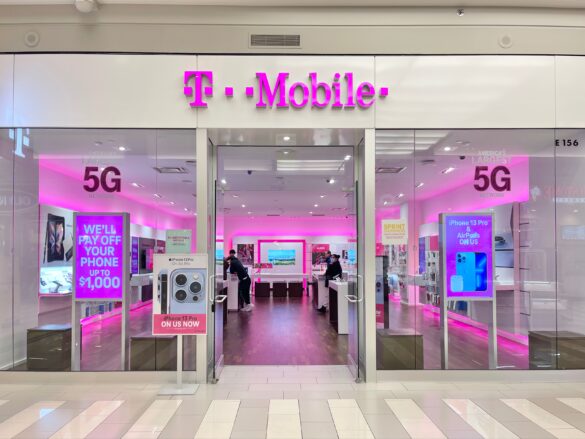
BELLEVUE, Wash. — For over a decade, T-Mobile has positioned itself as the bold disruptor of the U.S. wireless industry, a self-proclaimed “Un-carrier” shaking up the status quo with lower prices, innovative customer perks, and a relentless focus on building a superior network. Once the underdog struggling to keep pace with telecom giants, T-Mobile now claims it has reached the pinnacle of its 12-year journey to become the nation’s top wireless network.
At a high-energy event on Monday at T-Mobile’s 5G Innovation Hub in Bellevue, CEO Mike Sievert took the stage before a crowd of enthusiastic employees decked out in the company’s signature magenta. Broadcast live to a global audience, the event marked a historic moment for T-Mobile. Citing an independent study by Ookla, which analyzed over half a billion real-world data points, Sievert declared T-Mobile the best wireless network in the United States.

“This is the day we’ve been working toward for years,” Sievert said, his voice amplified by the cheers of the audience. “We’re not just competing with the big guys anymore—we’re leading the pack.”
The announcement comes five years after T-Mobile’s transformative merger with Sprint and 12 years after the company began its ascent from the bottom of the industry. Sievert didn’t shy away from acknowledging T-Mobile’s humble beginnings. “We were number four in networks,” he quipped, “and that’s only because there were four carriers to rank.”
Yet, T-Mobile’s rivals, particularly Verizon, are far from ready to hand over the crown. Verizon swiftly challenged T-Mobile’s claim, questioning the validity of Ookla’s crowdsourced testing methodology. In a statement, a Verizon spokesperson argued that crowdsourcing “lacks the scientific rigor needed for accurate comparisons,” citing issues with controlling variables and biases that can lead to “unpredictable and often inaccurate results.” Verizon instead pointed to RootMetrics’ controlled drive-testing data, which it claims demonstrates Verizon’s continued dominance in 5G reliability.
T-Mobile’s Case: A New Standard for Network Testing
T-Mobile executives were prepared for the pushback. During the event, Sievert preemptively addressed competitors’ likely critiques, warning the audience of “an attempt at obfuscation” from rivals clinging to their established reputations. He contrasted traditional drive tests—such as those used by RootMetrics, which involve a small number of testers driving predetermined routes—with Ookla’s approach, which T-Mobile describes as the most comprehensive network study ever conducted in the U.S.
“Drive tests are limited,” Sievert explained. “They typically involve 50 or so people driving cars along specific routes. Ookla’s study, on the other hand, draws from half a billion data points collected from millions of real users living their everyday lives—whether they’re at home, at work, or on the go.”
Sievert argued that this real-world data provides a more accurate reflection of the customer experience, a point echoed by T-Mobile’s leadership team. “We waited until the evidence was undeniable before making this claim,” said Jon Freier, president of T-Mobile’s Consumer Group. “This isn’t just a milestone for us; it’s a truth we’re ready to share with the world.”
A Transformative Journey
T-Mobile’s rise to the top is a story of persistence, innovation, and strategic risk-taking. The company’s turnaround began in 2013 under the leadership of former CEO John Legere, whose brash style and customer-first philosophy set the stage for T-Mobile’s transformation. Sievert, who was part of Legere’s executive team before taking the helm in 2020, emphasized the company’s long-term vision.
“I never imagined we’d get here,” Freier admitted, reflecting on his decades with the company, which trace back to the 1990s at Western Wireless, a predecessor to T-Mobile US. “This is the culmination of an improbable journey, one that required us to challenge every assumption about what a wireless carrier could be.”

The 2020 merger with Sprint was a pivotal moment, giving T-Mobile access to additional spectrum and infrastructure to accelerate its 5G rollout. Chief Operating Officer Srini Gopalan, who joined T-Mobile’s executive team in March 2025 after serving on its board, highlighted the company’s technical advantages. “We’re two years ahead of Verizon and AT&T,” Gopalan said. “With a 5G standalone core implemented five years ago, 30% more spectrum than Verizon, and 10-15% more cell towers than our closest competitor, our lead is only going to grow.”
T-Mobile’s growth is reflected in its numbers. In the first quarter of 2025, the company reported 130.9 million customer connections, including 1.3 million postpaid net additions and 495,000 postpaid phone additions—outpacing all other U.S. carriers. With the largest market capitalization among U.S. telecom companies, T-Mobile has solidified its position as an industry powerhouse.
Challenges Ahead
Despite its success, T-Mobile faces significant challenges as it transitions from scrappy upstart to industry leader. Industry analyst Avi Greengart of Techsponential noted that T-Mobile’s new status as the “cool establishment” brings unfamiliar pressures. “T-Mobile’s network is undeniably strong, and customers are happy with both speed and coverage—something you couldn’t say five years ago,” Greengart said. “But being the leader means you’re now the one everyone else is gunning for.”
One hurdle is winning over business customers, many of whom remain loyal to Verizon and AT&T due to longstanding relationships and tailored enterprise solutions. Consumer switching is also complicated by the prevalence of family plans, where moving a single line often requires coordinating multiple devices across extended families.
T-Mobile’s foray into satellite connectivity, through its partnership with Elon Musk’s Starlink, positions it as a pioneer in bridging the digital divide. However, competitors like AT&T, which has partnered with AST SpaceMobile, and emerging satellite initiatives from Amazon, Google, and Apple, pose significant threats in this nascent market.
“Having a better network and a compelling value proposition isn’t enough on its own,” Greengart cautioned. “T-Mobile has work to do to maintain its momentum.”
Staying True to Its Roots
After the event, Sievert spoke informally with a small group of analysts and reporters near the stage. When asked how T-Mobile plans to avoid the complacency that often plagues industry leaders, Sievert’s response was quintessentially T-Mobile—equal parts confident and combative.
“For years, I told my team that one day we’d be as big as or bigger than AT&T and Verizon, but we must never become them,” he said. “Our customer-loving hunger is in our DNA. You can’t just send out a memo and expect to replicate that.”

Sievert took a playful jab at his rivals, imagining a hypothetical scenario at a competitor’s headquarters. “Can you picture someone in an ivory tower saying, ‘We’ve studied T-Mobile’s customer-loving strategy, so starting tomorrow, everyone needs to care’? It doesn’t work that way.”
As T-Mobile navigates its new role as an industry leader, it remains committed to its Un-carrier ethos—challenging conventions, prioritizing customers, and pushing the boundaries of what a wireless carrier can achieve. Whether it can maintain that spirit while fending off fierce competition and meeting the demands of its growing customer base will determine if T-Mobile’s triumph is a fleeting moment or the start of a new era in telecom.
Related Developments
T-Mobile recently unveiled a new partnership with DoorDash, offering customers exclusive perks as part of its benefits program.
The company announced a launch date for T-Satellite, its Starlink-powered initiative to provide connectivity in remote areas.
Industry watchers expect ongoing debates over network testing methodologies, as carriers vie for supremacy in the 5G era.
FAQs
What is T-Mobile’s claim about being the best wireless network?
T-Mobile, led by CEO Mike Sievert, announced at a July 2025 event that it is now the nation’s top wireless network, based on an Ookla study analyzing over half a billion real-world data points from millions of users. This marks a milestone in T-Mobile’s 12-year journey from the industry’s underdog to a leader.
How does T-Mobile’s network testing method differ from its competitors?
T-Mobile relies on Ookla’s crowdsourced testing, which gathers data from millions of real users across diverse settings. In contrast, competitors like Verizon cite RootMetrics’ controlled drive tests, which involve fewer testers (around 50) on predetermined routes, arguing they offer more scientific rigor.
Why is Verizon challenging T-Mobile’s claim?
Verizon disputes T-Mobile’s claim, stating that crowdsourced testing lacks precision due to uncontrolled variables and biases. Verizon points to RootMetrics’ drive-test results, which it says demonstrate its superior 5G reliability.
What milestones contributed to T-Mobile’s rise?
T-Mobile’s ascent began in 2013 under former CEO John Legere’s “Un-carrier” strategy, focusing on lower prices and customer perks. The 2020 Sprint merger provided critical spectrum and infrastructure, while T-Mobile’s early adoption of a 5G standalone core gave it a technical edge.
What are T-Mobile’s current customer and network stats?
In Q1 2025, T-Mobile reported 130.9 million customer connections, including 1.3 million postpaid net additions and 495,000 postpaid phone additions, outpacing rivals. It has 30% more spectrum and 10-15% more cell towers than its closest competitor.
What challenges does T-Mobile face as an industry leader?
T-Mobile must win over business customers loyal to Verizon and AT&T, overcome switching barriers from family plans, and compete in the satellite connectivity space against players like AT&T’s AST SpaceMobile and initiatives from Amazon, Google, and Apple.
How does T-Mobile plan to maintain its “Un-carrier” identity?
CEO Mike Sievert emphasizes preserving T-Mobile’s “customer-loving hunger” as part of its DNA. He insists the company won’t fall into the complacency of its rivals, focusing on innovation and customer-centric policies to stay distinct.
What new initiatives has T-Mobile announced?
Alongside its network claim, T-Mobile unveiled a DoorDash partnership for customer perks and a launch date for T-Satellite, a Starlink-powered service to provide connectivity in remote areas, strengthening its competitive position.
Conclusion
T-Mobile’s declaration as the nation’s top wireless network in July 2025 marks a remarkable turnaround from its days as an industry underdog. Backed by Ookla’s extensive real-world data, the company’s 12-year journey—fueled by strategic moves like the Sprint merger and a bold 5G rollout—has reshaped the telecom landscape. However, challenges loom, from Verizon’s counterclaims and competition in satellite connectivity to the pressures of maintaining its “Un-carrier” ethos as an industry leader. T-Mobile’s ability to balance its scrappy, customer-first identity with the demands of its newfound status will determine whether it can sustain its lead and redefine what it means to be a telecom giant.
