United 777 Polaris Business Class Greetings from San Francisco, where I’ve just concluded my latest review journey. I recently flew United Airlines’ Boeing 777-300ER in Polaris business class on the relatively short 8-hour-and-15-minute hop from Tokyo Narita to San Francisco. It’s been quite a while since I last experienced Polaris on the 777, so I thought it was time to take another look and see how the product holds up in 2025.
My goal with this trip was to focus more on long-haul offerings from U.S. carriers. While they may not always be the most glamorous, they’re practical and helpful to many travelers — and they deserve a fair evaluation.
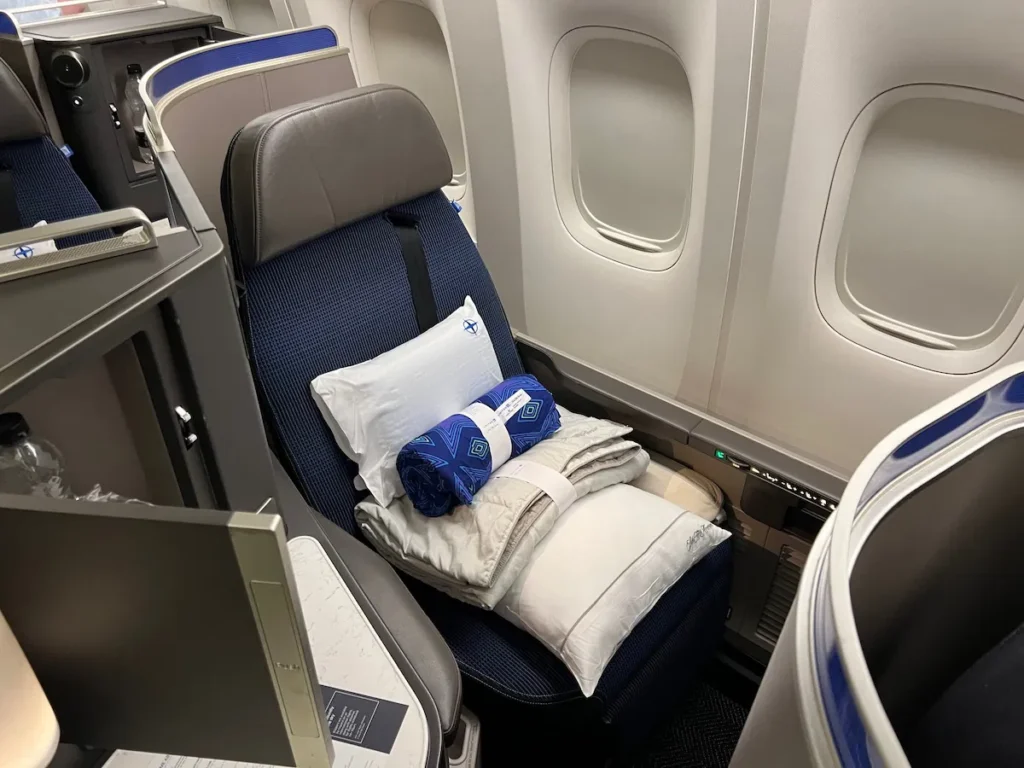
Despite its flaws, United Polaris continues to be a solid offering. The seats are good — not groundbreaking, but functional and well-designed. One thing United does particularly well is consistency across its fleet. That predictability matters. From the 767s to the 787s and most 777s, the same Polaris layout awaits, which isn’t something you can say about most other U.S. carriers — or even many top-tier international ones.
On this 777-300ER, the Polaris cabin is impressively large, featuring 60 business class seats arranged in a staggered layout. The true window seats remain the most private and desirable, with their tucked-away positioning and excellent views. Although the design is no longer cutting-edge, it’s still competitive. The predictability of the seat design across aircraft is a real strength, offering travelers reassurance about what they’ll get onboard.
Entertainment was another strong point. United offers a wide library of TV shows and movies that should suit most tastes. Their international Wi-Fi has also become reasonably reliable, which adds convenience for those needing to stay connected in the sky.
When it comes to comfort, United outshines many rivals in one key area: bedding. The partnership with Saks Fifth Avenue continues to pay dividends, and it’s no exaggeration to call Polaris the best in the business when it comes to sleep amenities. Between the plush duvet, the cooling gel pillow, and the day blanket, United truly transforms the seat into a cozy sleeping space. It’s clear this is one area the airline refuses to compromise on, and the result is a restful and elevated experience.

Less impressive, unfortunately, is the amenity kit. United currently offers a Therabody-branded version that doubles as a belt bag — or more plainly, a fanny pack. While this might appeal to a narrow demographic, it feels like a miss for a business class product. The design feels more suited for a casual tour group than a premium long-haul cabin, and the contents are equally underwhelming.
Read More: British Airways Club Suites Business Class Boeing 777 (IAD-LHR)
The weakest aspect of the flight, though, was the catering. When Polaris launched, it brought with it an ambitious revamp of onboard dining. United promised elevated cuisine, complete with thoughtful touches like pre-departure chocolates and wine flights. Sadly, much of that has fallen away over the years. The current food offering lags well behind expectations — and even behind competitors like American, which isn’t known for exceptional catering either.
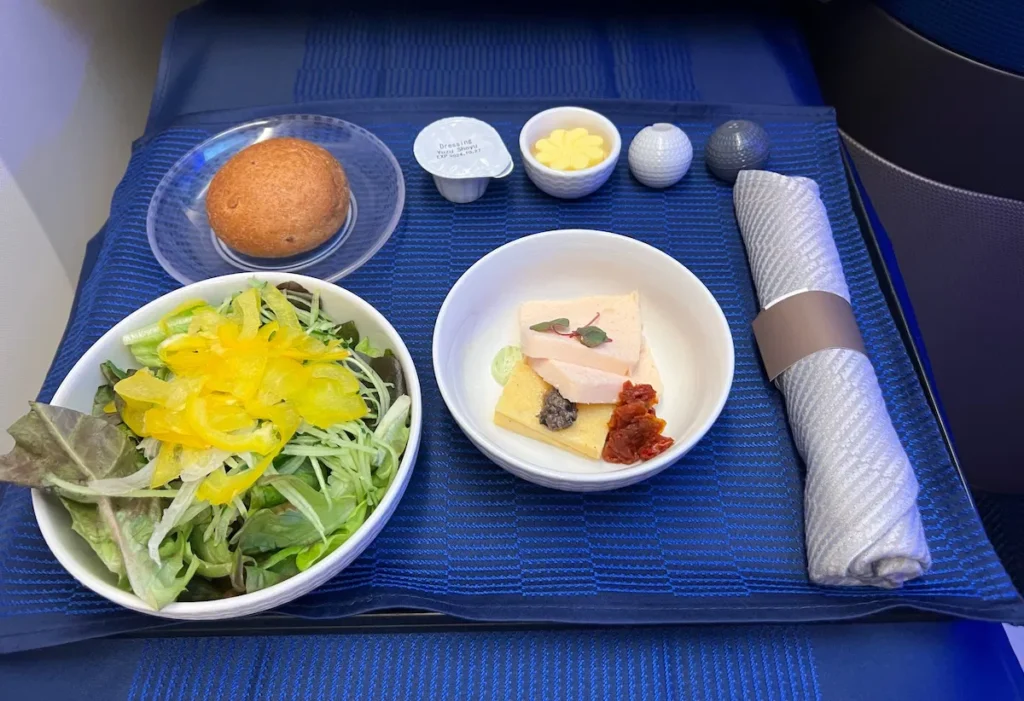
Dinner service kicked off after departure, with drinks and mixed nuts. I opted for a Diet Coke, while those interested in bubbly were offered Heidsieck Monopole Blue Top Brut Champagne. Unfortunately, the appetizer — a steamed scallop and crab dish with tomato, polenta, and basil mayo — was disappointing. It lacked flavor and had a mushy texture. A tired roll and bland salad didn’t help.
The main course, tofu isobeage with vegetables and rice, promised more than it delivered. While the concept sounded appealing, the dish turned out dull and uninspired. The teriyaki sauce was the only element adding any real flavor. Visually, the presentation straddled the line between airline chic and plastic restaurant model — neat but sterile.

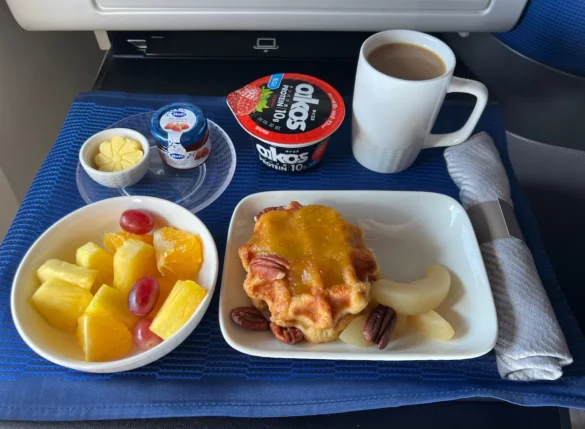
Dessert offered some redemption, with a classic ice cream sundae that was simple and satisfying. However, breakfast before landing was another letdown. The Western option — Belgian waffles with caramelized peaches and pecans — felt excessively sweet and more suited for a kid’s brunch than a business class cabin. Strangely indulgent after an already rich dessert hours earlier, it struck an odd note to end the flight.
What salvaged the experience was the service. While inconsistency is the norm with most U.S. airlines, I was lucky this time. The flight attendant, Rahul, exemplified what good hospitality should look like. He was warm, proactive, and refreshingly down-to-earth. He wasn’t putting on a performance — just doing his job well, and it made all the difference. It reminded me how much impact one excellent crew member can have on the overall experience.
Interestingly, this was my second consecutive long-haul flight on a U.S. airline where the service stood out. Perhaps that’s a good sign of improving standards — or just fortunate timing. Either way, the human element brought a sense of care that softened the rougher edges of the experience.
In the end, United’s 777 Polaris business class delivered a flight that was comfortable and reliable, if imperfect. The seat and bedding continue to be strong points, and when you get a great crew, it really enhances the journey. The catering may be a shadow of what Polaris once promised, but if your expectations are managed — and you’re fortunate with service — the overall product still holds appeal.
Polaris may not top the charts globally, but it offers something many business travelers value: consistency. Knowing what you’re getting when you book goes a long way, and for that reason alone, I wouldn’t hesitate to fly Polaris again.
