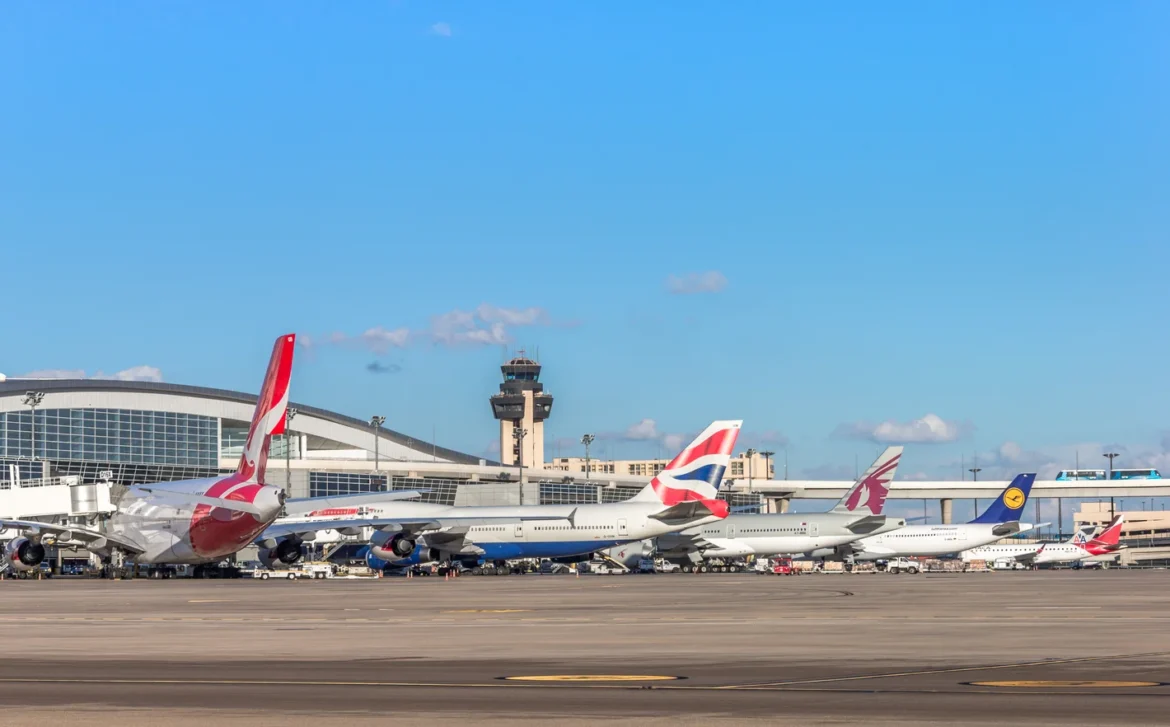
Dallas Fort Worth International Airport (DFW) ranks as the third busiest airport in the United States, welcoming over 81 million passengers in 2023. The airport’s size is remarkable, exceeding that of Manhattan, and it is the only U.S. airport with its own ZIP code. Despite its vast footprint, DFW remains user-friendly, offering streamlined terminal navigation, frequent transit options, and extensive amenities.
Strategically located between Dallas and Fort Worth, the airport is a significant hub for both domestic and international travel. American Airlines operates primarily from this airport, controlling three of the five terminals, thus making DFW a key component in the airline’s route network.
Terminal Layout and Infrastructure
DFW’s design optimizes efficiency and minimizes congestion. Five main terminals—A, B, C, D, and E—are spread around the airport in a semi-circular layout, with Terminal D as the international terminal. Each terminal is independently accessible from International Parkway/State Highway Spur 97, which bisects the airport from north to south.
Terminals A, B, and C are interconnected by post-security walkways, while Terminal D is linked to Terminals B and C. Terminal E stands apart without any airside walkway connections, making ground transportation more critical for transfers.
Ground Transportation Options Before Security
The Terminal Link shuttle bus provides a complimentary and efficient way to move between terminals without passing through security. Operating from 5 a.m. to midnight, with after-hours service available by calling 972-574-5465, the bus stops every 8 to 10 minutes at designated pick-up zones.
Key pickup points include:
- Terminal A: Entrances A10 and A16 (Departures Level)
- Terminal B: Entrances B14 and B43 (Departures Level)
- Terminal C: Temporary location near entrance C17 (Arrivals Level)
- Terminal D: Entrances D17 and D29 (Arrivals Level)
- Terminal E: Entrances E14 and E35 (Departures Level)
Passengers can scan QR codes at each shuttle stop to track bus arrival times.
Skylink Train for Post-Security Transfers
Once inside the secure area, the Skylink light rail system offers fast, free, and convenient transportation between all terminals. Operating in both clockwise and counterclockwise directions, the Skylink departs every two minutes and completes a full loop in under 10 minutes.
Each terminal hosts two Skylink stations:
- Terminal A: Between gates A13–A16 and A29–A34
- Terminal B: Between gates B9–B14 and B28–B43
- Terminal C: Between gates C8–C12 and C27–C35
- Terminal D: Between gates D11–D20 and D24–D34
- Terminal E: Between gates E8–E11 and E31–E34
Detailed Terminal Breakdown
Terminal A Located on the east side, Terminal A features 26 gates, from A8 to A39. American Airlines operates exclusively here. Terminals B and C are accessible via post-security walkways or the Skylink train. The terminal also includes entry points for Terminal Link at A10 and A16.
Terminal B Positioned opposite Terminal A on the west side, Terminal B offers 44 gates. The terminal connects airside to Terminals A and D via escalators and walkways. Skylink stations are located between B9–B14 and B28–B43. Shuttle pick-up zones are at entries B14 and B43.
Terminal C Terminal C, currently under renovation, has 25 gates. It is flanked by Terminals A and E, though only Terminals A and D are accessible via airside corridors. Skylink connections are available at gates C8–C12 and C27–C35.
Terminal D Known as the international terminal, Terminal D includes 33 gates. It features a luxury hotel and a broader range of dining and retail outlets. The terminal connects to Terminals B and C through walkways and is equipped with Skylink stations near D11–D20 and D24–D34.
Terminal E Terminal E comprises 43 gates and a separate satellite concourse. It lacks direct airside walkways to other terminals, relying solely on the Skylink for secure transfers. Terminal Link shuttle access is provided at entries E14 and E35.
Estimated Walking Times Between Terminals
While the Skylink is the quickest transport method, walking between adjacent terminals is often more efficient, especially between lower- and higher-numbered gates.
Approximate walking times include:
- 5–10 minutes: Between Terminals A–B, A–C, B–D, C–D
- 10–20 minutes: Between Terminals A–D, B–C
Flight Connection Procedures
For domestic connections, passengers can remain within the secure area and use either walkways or the Skylink. For international arrivals, travelers must clear customs and immigration, collect baggage, and pass through security again before proceeding.
Travelers on connecting flights booked on a single itinerary can drop their rechecked luggage at the designated counters and proceed through security to use the Skylink. Those with separate tickets must check in again with their airline.
Accessibility Services and Support
DFW provides accessible infrastructure across all terminals. Elevators, escalators, and moving walkways are available. The Skylink system is ADA-compliant with designated seating. Terminal Link buses and parking shuttles accommodate wheelchairs. Wheelchair services can be arranged through respective airlines.
FAQs
How do passengers move between terminals?
Terminal Link shuttle buses operate outside security, while Skylink light rail facilitates movement inside the secure zone. Both services are complimentary and efficient.
Are all DFW terminals interconnected?
Airside walkways link all terminals except Terminal E. The Skylink train ensures secure transfers among all five terminals.
Which terminals are used by American Airlines?
American Airlines exclusively occupies Terminals A, B, and C, and also operates from Terminals D and E.
Where are international flights processed?
Most international flights operate from Terminal D, which includes customs and immigration facilities for arriving international passengers.
How accessible is DFW for disabled travelers?
The airport provides comprehensive accessibility services, including elevators, moving walkways, wheelchair access on shuttles and trains, and airline-assisted mobility options.
Conclusion
Dallas Fort Worth International Airport delivers a robust and efficient passenger experience. Its extensive terminal network, seamless transportation systems, and smart infrastructure design make it one of the most navigable large airports in the world. Whether transferring between gates or navigating international connections, DFW provides clarity, speed, and convenience.
