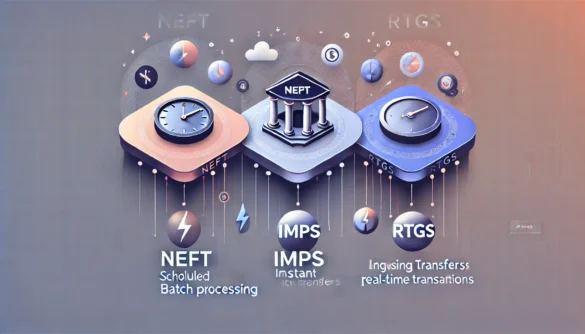
In today’s digital world, transferring money has become faster, easier, and more accessible than ever before. Whether you’re paying bills, transferring funds to family members, or making business payments, knowing the difference between NEFT, IMPS, and RTGS can help you make the right choice for your needs.
But why is it that people still choose one method over the other, especially when IMPS and RTGS offer real-time transfers, unlike NEFT? And when RTGS has significantly higher limits than IMPS, why would anyone choose the latter over the former?
In this article, we will explore these questions, breaking down the three money transfer methods, their features, limitations, and when to choose one over the other. Let’s dive into the world of electronic money transfers!
What is NEFT?
An Overview of NEFT
National Electronic Funds Transfer (NEFT) is one of the most widely used money transfer systems in India. It allows individuals to send money between banks on a real-time basis but operates in batches. Unlike IMPS and RTGS, which provide immediate settlement, NEFT transactions are processed in intervals—typically every half an hour.
Key Features of NEFT
- Not Real-Time: NEFT operates in batches, meaning transactions are not completed instantly. Transfers happen in a series of intervals, unlike the immediate processing provided by IMPS and RTGS.
- Transaction Limits: The minimum and maximum amounts you can transfer are set by the banks, but typically, the amount is not a restriction for most users.
- Availability: NEFT is available 24×7, but it is limited by batch timings for settlements.
- Affordable: Compared to IMPS and RTGS, NEFT is usually cheaper in terms of service charges.
Why Choose NEFT Over IMPS/RTGS?
So why would anyone choose NEFT over IMPS or RTGS if those options are faster and more efficient? Let’s explore a few scenarios.
- Lower Charges: For transfers that don’t need to be immediate, NEFT is often the most cost-effective option.
- Non-Emergency Transfers: If you are not in a hurry to complete the transaction, NEFT can be the go-to method, particularly for transfers that don’t need real-time settlement.
- Easy Access: Many banks allow NEFT transactions even through mobile apps and Internet banking, making it easy for the average person to use.
- Flexibility in Limits: While IMPS and RTGS have stricter limits, NEFT often allows for more flexibility in terms of the amounts you can transfer.
What is IMPS?
The Rise of IMPS
Immediate Payment Service (IMPS) was introduced as a real-time electronic payment system for instant money transfers. It is an ideal method for users who require quick, on-the-go transactions, such as during emergency fund transfers or for small transactions.
Key Features of IMPS
- Real-Time Transfers: Unlike NEFT, IMPS allows for instant money transfers. No waiting, no delays.
- Transaction Limits: Typically, IMPS has lower daily transfer limits compared to RTGS, though the upper limit is still quite high for regular users.
- Accessibility: IMPS is available 24×7, which makes it more flexible than NEFT in terms of availability.
- Service Charges: Depending on the bank, IMPS may involve higher service charges compared to NEFT.
Why Choose IMPS Over RTGS?
You may wonder, if RTGS offers higher transaction limits and can handle large sums of money, why would anyone choose IMPS? Let’s dig into some key reasons:
- Speed: While RTGS offers higher limits, it is generally used for large value transactions and isn’t designed for small, quick transfers. IMPS, on the other hand, is ideal for immediate, smaller transactions.
- Accessibility: IMPS allows for quick transfers through mobile apps, making it more convenient for individuals looking to make a transfer on the go, compared to RTGS.
- Cost: If you are transferring a smaller sum of money, IMPS might be more affordable than RTGS, which could have higher charges associated with it.
- Convenience: IMPS can be accessed through various channels, including mobile apps, ATMs, and Internet banking. RTGS typically requires the user to approach a bank branch or perform online banking.
What is RTGS?
RTGS: The Big Leagues of Transfers
Real Time Gross Settlement (RTGS) is designed for high-value transactions that require instant processing. Unlike IMPS, which is designed for smaller, real-time transfers, RTGS deals with much larger sums and has a different set of features.
Key Features of RTGS
- Real-Time Settlement: As the name suggests, RTGS transfers are processed and settled in real-time, with no delays.
- High Transfer Limits: One of the primary advantages of RTGS over IMPS is its high transfer limits. RTGS can handle transactions running into crores, making it perfect for businesses and large payments.
- Transaction Timing: Unlike NEFT or IMPS, RTGS operates during the working hours of banks. It isn’t available 24×7.
- Service Charges: The charges for RTGS transactions are generally higher compared to IMPS.
Why Choose RTGS Over IMPS?
So, when IMPS is instant and widely available, why would anyone go for RTGS? Here are some reasons:
- High-Value Transfers: RTGS is the best option for those who need to transfer large sums of money, usually above ₹2 lakhs, a limit that IMPS can’t match.
- Greater Reliability: RTGS offers a secure and reliable system for large transactions, which is often required in businesses or government payments.
- No Limits: Unlike IMPS, RTGS has a much higher limit for daily transfers, which makes it suitable for companies or individuals looking to move substantial amounts.
- No Delays: RTGS provides a real-time settlement, ensuring that the funds are credited immediately.
NEFT Vs IMPS Vs RTGS: A Quick Comparison
Transfer Speed
- NEFT: Processed in batches, not real-time.
- IMPS: Real-time transfer.
- RTGS: Real-time, high-value transfer.
Transfer Limits
- NEFT: Flexible; depends on the bank.
- IMPS: Up to ₹2 lakh per day.
- RTGS: ₹2 lakh and above; no upper limit.
Transaction Costs
- NEFT: Lowest charges.
- IMPS: Moderate charges.
- RTGS: Higher charges for large transfers.
Availability
- NEFT: Available 24×7, batch-based processing.
- IMPS: Available 24×7, real-time.
- RTGS: Available during banking hours, real-time.
Suitability
- NEFT: Non-urgent, low-cost transfers.
- IMPS: Urgent, small transfers.
- RTGS: Large, high-value, urgent transfers.
Frequently Asked Questions
What is the difference between NEFT, IMPS, and RTGS?
NEFT (National Electronic Funds Transfer), IMPS (Immediate Payment Service), and RTGS (Real-Time Gross Settlement) are three types of electronic fund transfer methods in India. NEFT is a batch-based system, with transfers processed at intervals throughout the day. IMPS offers instant transfers 24/7, while RTGS handles high-value, real-time transfers between banks. RTGS operates during banking hours and is suited for larger transactions, while IMPS and NEFT are better for smaller amounts.
Which transfer method is the fastest: NEFT, IMPS, or RTGS?
IMPS is the fastest among the three methods, as it allows for instant transfers 24/7. NEFT transfers are processed in batches, so they may take a few hours to complete. RTGS also offers real-time settlements but is typically reserved for high-value transactions and operates only during banking hours.
Are there any transaction limits for NEFT, IMPS, and RTGS?
Yes, each method has its own limits. IMPS generally has a limit of ₹2 lakh per transaction, NEFT does not have a maximum limit but may have lower daily limits set by individual banks, and RTGS is used for high-value transactions with a minimum amount of ₹2 lakh and no upper limit.
Which transfer method is best for urgent payments?
IMPS is the best option for urgent payments, as it is instant and available 24/7, including on holidays. RTGS is also fast, but only available during banking hours. NEFT is slower, as it operates in batches and can take several hours.
Is there any fee associated with NEFT, IMPS, or RTGS transfers?
Yes, all three methods may have transaction fees, though they vary by bank and the amount being transferred. IMPS fees are generally higher than NEFT, especially for larger transactions. RTGS also tends to have higher charges, particularly for larger sums, due to its high-value transaction nature. However, many banks offer free or nominal charges for transfers under certain conditions.
Conclusion
Ultimately, choosing between NEFT, IMPS, and RTGS comes down to your specific needs. If you need a quick, cost-effective transfer without urgency, NEFT might be your best bet. For instant, smaller transactions, IMPS is a strong contender, offering speed and flexibility. On the other hand, if you’re transferring large sums of money and need real-time settlement, RTGS is the way to go.
